
Here is an overview of the different eyelet shapes for Extension springs after DIN EN 13906-2: 2013 with the respective loop properties. Extension springs should only be subjected to static loads. If higher loads are planned, bent eyelets should be avoided and rolled or screwed-in end pieces should be used. Is useful at more stressed extension springs also a life test under real operating conditions.
With the respective Loop properties please note the dimensions, for example the 1/1 German eyelet the value Lh (Distance between the inner edge of the eyelet and the spring body) only between 0.8 and 1.1 Tuesday (inner coil diameter). In addition, with the specification m the eyelet opening width can be specified.
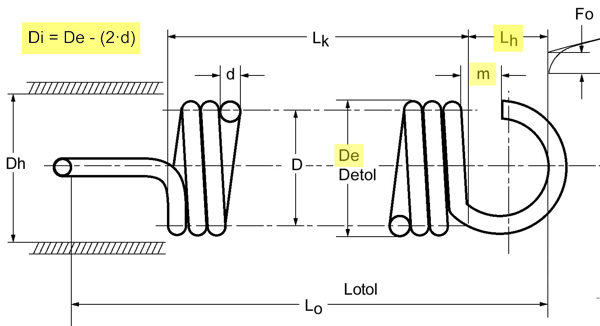
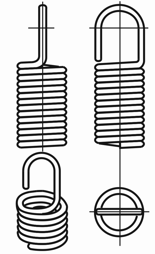
1/1 German eyelet
Additional information: Lh and m
(Lh = 0.8 to 1.1 Di)
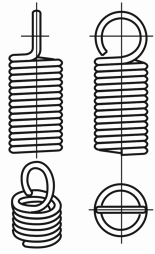
Additional information: Lh and m
(Lh = 0.8 to 1.1 Di)
1/1 double German eyelet
Additional information: Lh
(Lh = 0.8 to 1.1 Di)
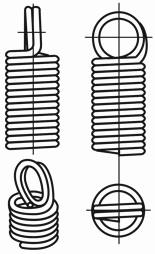
Additional information: Lh
(Lh = 0.8 to 1.1 Di)
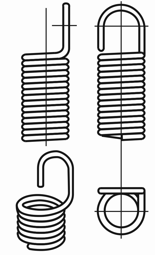
1/1 German eyelet raised at the side
Additional information: m
(Lh ~ Di)
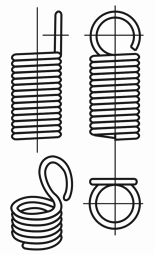
Additional information: m
(Lh ~ Di)
1/1 double German eyelet raised on the side
Additional information: None
(Lh ~ Di)
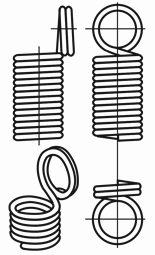
Additional information: None
(Lh ~ Di)
1/1 German eyelet raised at an angle
Additional information: m
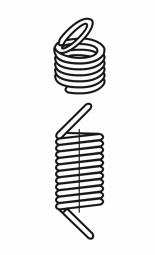
Additional information: m
1/2 German eyelet
Additional information: Lh and m
(Lh = 0.55 to 0.8 Di)
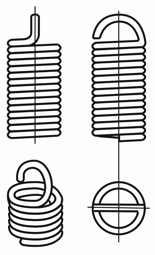
Additional information: Lh and m
(Lh = 0.55 to 0.8 Di)
English eyelet
Additional information: m
(Lh ~ 1.1 Di)
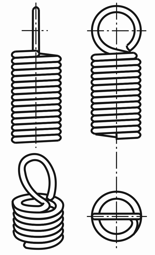
Additional information: m
(Lh ~ 1.1 Di)
Hook eye
Additional information: Lh and m
Additional information: Lh and m
Hook eye raised at the side
Additional information: Lh and m
Additional information: Lh and m
Hook rolled up
Additional information: Drawing !
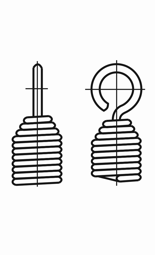
Additional information: Drawing !
Threaded bolt rolled
Additional information: Drawing !
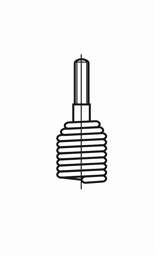
Additional information: Drawing !
Threaded plug screwed in
Additional information: Drawing !
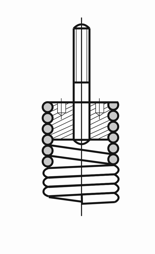
Additional information: Drawing !
Screw-in screw tab
Additional information: Drawing !
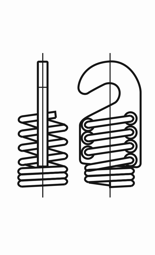
Additional information: Drawing !
Eyelet shapes extension springs