
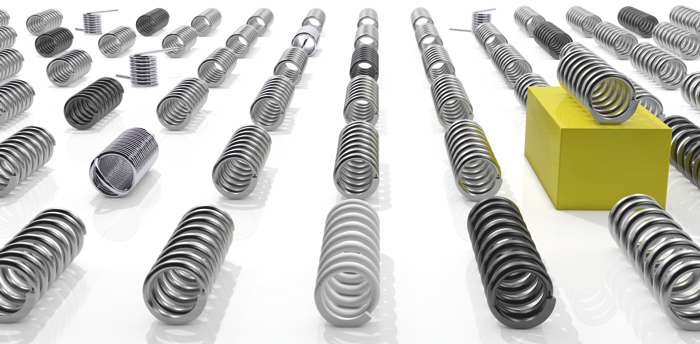
Metal springs play an important role in the production, processing and packaging of foodstuffs. From food processing to filling systems and packaging, compression springs, extension springs and torsion springs provide reliable forces in countless processes. They have to work with mechanical precision and meet the strictest hygiene and safety standards. What functions do the different spring types perform? Which material and surface requirements are important in the food environment? Gutekunst Federn explains how to choose the right spring in a practical and compact way below.
Table of Contents
Compression springs in the food industry
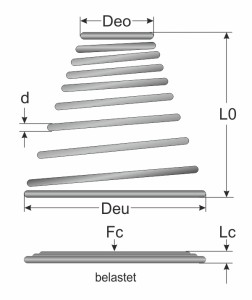
Compression springs, also known as helical springs, are mechanical force accumulators that absorb forces when compressed and release them again when released. They are characterized by a mostly linear displacement-force characteristic (spring characteristic spring constant), which can be defined by a cylindrical spring geometry and spring material selection. If the spring geometry is conical or double-conical, the compression spring can also provide a progressive displacement-force characteristic curve. For this purpose, the conical design can also be designed so that the coils interlock. This means that the compression spring can also be used in axially restricted installation spaces where the block height of the spring corresponds to approximately twice the wire thickness.
See further information at https://blog.federnshop.com/en/information-compression-springs/
In the food industry, compression springs are used in:
- Filling and sealing technology: through defined contact pressure, guidance and centering.
- Valves / process valves: by resetting and holding closing forces.
- Dosing units: thanks to reproducible restoring forces and tolerance compensation.
- Conveyor and packaging machines: with sprung bearings, buffering and force compensation.
Special design information for compression springs:
- Guide to prevent buckling: Slim compression springs require a mandrel or sleeve to prevent lateral deflection.
- Avoid friction: Any friction must be avoided by design, as the resulting heat causes a loss of spring force. This change in the spring effect is called hysteresis.
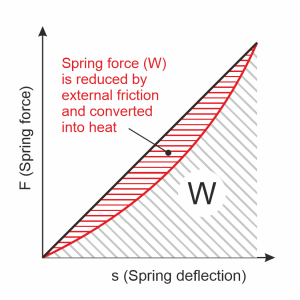
- Take setting behavior into account: Compression springs can lose spring force under permanent tension and higher temperatures. This loss of force is called relaxation. This is taken into account in the spring design as a percentage of the initial force “F1”.
- Fatigue strength: Compression springs can be designed for fatigue strength (10 to the power of 7 load cycles). Conical, double-conical and beehive springs, with a progressive spring characteristic, support the fatigue strength of compression springs.
Extension springs in the food industry
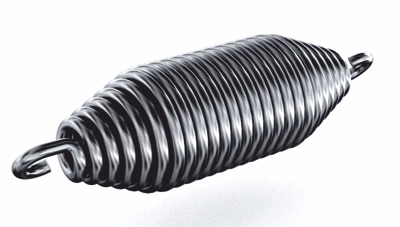
Tension springs are mechanical force accumulators which, in contrast to compression springs, absorb forces when they are pulled apart (when stretched) and release them again when they are released. The cylindrical tension spring also has a linear displacement-force characteristic, which is defined by the spring geometry and spring material selection. With conical or double-conical spring geometry, the tension spring provides a progressive displacement-force characteristic curve. A characteristic feature of the tension spring is the preload (FO), which is created by the closely spaced coils. This is advantageous for pretensioning mechanisms without play. The design of the spring ends is particularly versatile with extension springs: in addition to the usual German eyelet, English eyelet or individual hook shape, screwed-in or rolled-in spring ends can also be used for heavy loads.
See further information at https://blog.federnshop.com/en/information-extension-springs/
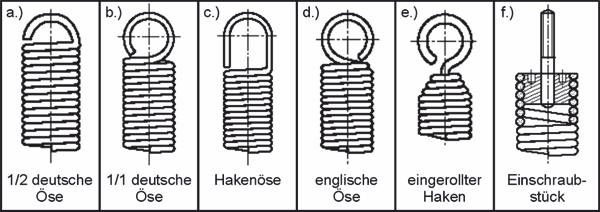
In the food industry, tension springs are used in:
- Conveyor technology: for clamping and resetting elements, compensation of tolerances.
- Packaging machines: for resetting grippers and for film tensioning.
- Protective covers / doors / maintenance flaps: for fixing and return.
Special design information for tension springs:
- Eyelets as a weak point: Increased bending stress at the transition bend to the eyelet increases the risk of eyelet breakage. The centric application of force at the apex of the eyelet is advantageous here.
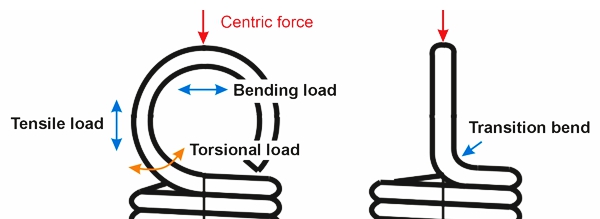
- Avoid lateral forces: Only load tension springs in the axial direction.
- Tapered design: Tapered or conical tension spring designs have a progressive spring characteristic and can lead to a longer service life.
Torsion springs in the food industry
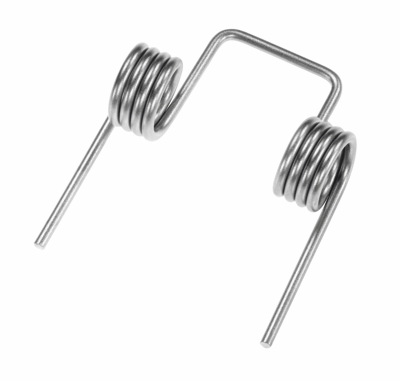
Torsion springs, also known as torsion springs, differ fundamentally from compression and tension springs. They consist of a spirally wound spring body and two protruding legs. In contrast to compression and tension springs, which are subjected to compression and tension (axial) loads, torsion springs exert a torque on the legs via the angular movement of the legs during the return movement. In addition to the spring body, the decisive factors for the design are the leg length, the bending of the legs, the winding direction, which can be coiled to the right or left, and the spring mounting via a mandrel or an axle. The double leg spring is also a leg spring with two oppositely wound spring bodies, which is used in particular for applications with increased spring force in tight installation spaces. Thanks to its symmetrical design, the double leg spring also has a more even force distribution and stability.
See further information at https://blog.federnshop.com/en/information-torsion-springs/
In the food industry, torsion springs are used in:
- Flaps, hinges, covers: Restoring torques on inspection and maintenance flaps.
- Lever and latching mechanisms: defined holding torques, resetting of operating levers.
- Clamping and tensioning functions: spring-loaded clamps/locks in assemblies.
Special design information for torsion springs:
- Define the installation position correctly so that the spring is loaded in the direction of the winding.
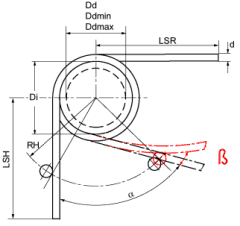
- Force application leg: The further the force application point is from the center of the spring body, the leg deflection (ß) must be taken into account in the spring performance.
Special requirements for metal springs in the food environment
Metal springs in the food environment are subject to strict requirements to ensure food safety, hygiene and corrosion resistance. The following properties must therefore be guaranteed for metal springs.
- Corrosion resistance to moisture, salt, acids/alkalis and cleaning chemicals
- Smooth, easy-to-clean surfaces (low roughness, little adhesion)
- Hygienic design of the spring ends: Eyelet areas are geometrically “complex” and must remain easy to clean
- Cleanability of the bearing point: Spring often sits on a mandrel or inside a sleeve – food residue can collect there.
- Avoidance of particle abrasion and surface defects (hygienic design)
- Resistance to cleaning cycles: repeated CIP/SIP phases, temperature changes, condensate.
Material requirements in the food industry
Special requirements apply to the materials and surface treatments used in the food industry. Metal springs that may come into contact with food must be made of food-safe spring steel wire grades. Stainless steels such as 1.4310 (X10CrNi18-8), 1.4301 (X5CrNi1810) or 1.4401 (X5CrNiMo17-12-2) are frequently used. Its smooth, protective and stable chrome oxide layer is the decisive reason for this. This makes the metal springs corrosion-resistant. This means that the metal is not attacked when it comes into contact with food or by environmental influences such as oxygen and cleaning agents. stainless steel has further advantages in terms of hygiene: The material does not leave any harmful substances or particles when it comes into contact with food. This prevents users from contaminating or altering the food. Stainless steel is also very easy to clean. It also prevents germs and bacteria from gaining a foothold.
If required, an additional surface treatment makes the metal springs resistant to higher corrosion loads and high temperatures or restores their conductivity. Possible procedures are Chrome plating , Tin or coating with Teflon (PTE) .
Selection criteria for springs in the food industry
When selecting the right metal spring for an application in the food industry, various factors must be taken into account:
- Operating temperature: The temperature influences the mechanical properties of the spring. In the food industry, high temperatures can occur during sterilization processes or low temperatures in cooling areas.
- Type of load: For dynamic loads, compression springs and occasionally tension springs with screwed-in spring ends are mainly suitable. Torsion springs are the only choice for rotary movements.
- Corrosion resistance: In humid environments or in contact with aggressive cleaning agents, high corrosion resistance of the spring material is required, possibly with additional surface treatment.
- Space requirement: Conical compression springs offer advantages with limited axial play. Torsion springs can often be integrated into mechanisms to save space.
- Hygiene requirements: Springs should be easy to clean and offer no niches in which food residues or microorganisms can accumulate.
The correct selection and dimensioning of metal springs is crucial for the reliability and service life of machines and systems in the food industry. Experienced spring manufacturers such as Gutekunst Federn offer support in the development and selection of springs for specific applications.
Thanks to the use of modern production technologies and suitable materials and surface treatments, metal springs can now be optimally adapted to the requirements of the food industry, resulting in a longer service life and improved food safety.
More information and further knowledge about compression, tension and torsion springs and their areas of application can be found at blog.federnshop.com. You can reach the Gutekunst Federn technical department at technik@gutekunst-co.com.
Related Links: